PAST
Between 1876 and 1879, death sat down at the Gaudí family table and left three empty chairs. First it took Francesc, his brother; next Antònia, his mother; then Rosa, his sister. It was as if the load-bearing walls of Gaudí’s soul had been torn out. Without a doubt, the hard process of losing everything had begun.
Gaudí would set sail on a voyage from which he could never disembark, a voyage that would carry him into deep waters, a voyage that would begin in 1882, when the first stone of the Expiatory Temple of the Sagrada Família was laid in El Poblet, a poor neighborhood on the outskirts of Barcelona. The appointed architect was Francisco de Paula del Villar. A man of prestige who had a conventional neo-Gothic temple in mind. And in the crowd there appeared a young architect of thirty. That young man was Antoni Gaudí. Nobody. Nobody remembers him. He is there by chance, like someone attending a stranger’s wedding. But providence was already weaving a plan.
Del Villar soon clashed with the man who had driven the project, Mr. Bocabella, and with the board, which included the architect Martorell. The disagreements multiplied and Del Villar resigned, but Martorell himself did not want to carry on either. However, he recommends to the board of trustees in charge of construction the young man he had invited to the laying of the first stone, the architect then embarking on a meteoric career: he calls on Antoni Gaudí.
And here comes the detail nobody tells. Gaudí had not criticized Del Villar, so Del Villar did not turn against him. Nor had he put himself forward as an alternative. And that discretion — that absence of ambition — was precisely what opened the door to the greatest work of his life.
And so, on March 19, 1885, three years after the first stone, the Chapel of Saint Joseph in the crypt is inaugurated. This is symbolic, and here a path of “God-incidences” begins to be written. The Chapel of Saint Joseph is the first space Gaudí designs entirely for the Sagrada Família. Saint Joseph. The adoptive father. The silent man. The one who is not the protagonist of the Gospels, yet holds up the story from the shadows. Gaudí chooses Saint Joseph as his first devotion. It is no coincidence. Gaudí, too, will be, in his own way, a man who builds in silence and holds up a colossal work from the shadow of faith.
That is how he enters the Sagrada Família through the back door, almost as a replacement. But that replacement would change the history of architecture forever. The Sagrada Família was not a commission; it was a prophecy. It was the river that swept Gaudí into deep waters, but at the bottom of those waters Gaudí does not drown; he is purified as his faith is put to the test.
The second sign would come in 1891: eight years after Gaudí took the reins of construction, the Sagrada Família lay dying amid empty scaffolding. Donations trickled in. Desperate at watching it all collapse, and just when everything seemed lost, Gaudí witnessed the lightning bolt of Providence, which burst in unannounced and faceless.
Two years earlier, in 1888, Isabel Bolet i Vidiella had died. She was the widow of the owner of a major ironworks, and in her will she left a single wish: to sell everything and give every last cent to the construction of the Sagrada Família. The donation was colossal: more than half a million pesetas, a fortune at the time. Isabel Bolet is the “faceless lady” because no one knew her, Gaudí included. No one could thank her while she was alive. But without her, the Sagrada Família we know today simply would not exist. Gaudí knew it and always acknowledged her throughout his life.
In the midst of that deep crisis, the arrival of Divine Providence shakes Gaudí to the core. The miracle happened, and what is more, it was worked by a woman who had died two years before. Gaudí would see the first miracle, but not the last.
Intrigued, he sought an explanation. In Astorga, within the walls of the Episcopal Palace, Bishop Joan Bautista Grau i Vallespinó gave Gaudí that light and showed him the liturgy as a language, a rite, a symbol and a calendar. It was not a talk; it was an immersion in something profound. And he left him a warning that would burn in his heart forever: “Build something that measures up. It is not only about raising stones. It is about raising a temple worthy of God.”
On September 18, 1893, his friend the bishop died of an infection. What he saw and felt as he watched his friend and mentor in the faith die marked him forever. That is where the mystic was born. Grau taught him to read heaven in the liturgy, and Gaudí later set it down in the Sagrada Família and in Mallorca with a precision that still astonishes theologians.
A year later, in search of clarity, something unexpected would close that circle with decisive force. Gaudí enters forty days of fasting and contemplation so that he might feel and see his temple. There he imagines three façades, eighteen towers. Forty days in which Gaudí falls deathly ill and risks his life, but finds God. “They gave me up for dead,” he would later say.
The body falls, but something within rises. Biographers agree: 1894 is the year of his definitive conversion. Without that brief death, the Gaudí we know would not exist. The Sagrada Família we admire today was born of that Lent, when the architect understood that stone prays too.
PRESENT
José Manuel Almuzara is at the Colegio de las Teresianas. And at the entrance he shows us a phrase carved into the floor that stops him in his tracks. It is a phrase by Saint Teresa of Jesus. A phrase that takes on a new meaning: “Let nothing disturb you” — it is Gaudí writing a prayer in stone. In 1887, just four years after Gaudí took charge of the Sagrada Família, while he was building the Colegio de las Teresianas, the Catalan genius was already tracing the first lines of his transformation.
Almuzara moves forward and we enter the building. And then he sees the stairs. A staircase that leads nowhere. A staircase that climbs and climbs but does not lead to any room. A staircase that is, in fact, a symbol of a different Gaudí, because he already speaks to us through his architecture, but above all, he guides us. What is Gaudí trying to suggest to us?
The staircase, as the soul’s path toward God, points upward: to climb, to ascend. Step by step. Gaudí used to say, “Man must ascend step by step: in intelligence, in virtue, in strength.” But perhaps Gaudí wants to tell us that it is not about climbing for the sake of climbing, and that we must not be mistaken in the staircase we choose, the one before us: not all of them lead to God, to the seventh mansion. But there is more. Almuzara discovers that there are no coincidences. Everything in Gaudí’s work holds a clue. Everything points to something. From here on, Gaudí begins to create a deeper, more sublime narrative for the viewer. It is a dialogue. A dialogue of faith. In his work there are no coincidences, because there are none in his faith either.
As an audience, we discover that Gaudí’s work is also a coded message. A message of transformation, of ascent. And that message clearly begins here, at the Teresianas, with a staircase that leads us nowhere, yet, seen through the soul, leads us to God. Let us not mistake the staircase of our lives.
To reason, an absurdity. To faith, a certainty, because some paths are traveled not with the feet but with the soul. It was his way of saying that not everything can be seen. That not everything can be explained. That there is an invisible architecture holding up the visible one. And that sometimes, to climb, you must accept that the staircase stops.
Years later, Gaudí would remember those stairs. And he would understand that his whole life was just that: a staircase climbing toward something he could not see, but knew was there.
The stairs of the Colegio de las Teresianas show us how the young architect who had come to the Sagrada Família seeking recognition and fortune was ceasing to exist.
In his place, another man was beginning to be born. A man who was not yet a mystic, but who already sensed that architecture could be something more than construction. It could be prayer. But later it would become the way Gaudí communicated with God.
And then came something improbable, yet true. While directing the design and construction of the Sagrada Família, he was looking for inspiration to define its sculptural work, and a scene stopped him cold. But he did not conceive it in his workshop or in a book: it came after a visit to the Hospital de la Santa Creu, the hospital of the poor. There, at his bedside, he kept company with a poor man who was awaiting death alone, in poverty. Gaudí looked at him and could not forget him.
Back at the workshop, he called in Llorenç Matamala, his inseparable sculptor, the man who translated into clay and plaster what the architect saw in stone. Together they conceived a sculptural group, carved in stone, to be placed in the niche of the Amen of the Hail Mary in the inner cloister of the Sagrada Família: The Death of the Just. In this way they gave shape to a scene in which we see a man alone, abandoned, surrendering his soul to Jesus, Mary and Joseph. It was not a decorative theme. It was a prophecy.
Matamala modeled the figure. Gaudí corrected it, refined it, prayed over it. He wanted that anonymous dying man to have a face, hands, a posture that spoke of dignity in destitution. He wanted the stone to say what he had seen: that one can die dispossessed and still be just. That poverty does not take away grace. That loneliness does not take away the presence of God.
And then, the stone foreshadowed life. Gaudí did not know it yet, but twenty years before his passing he was sculpting his own end: the very same place, and the very same way, in which Antoni Gaudí would cease to exist.
T H E E N D.
By the end of this first episode, the viewer has seen the young architect who receives an impossible commission. They have seen how providence worked in the man who fasts almost to death. They have seen the friend who mourns a death. They have seen the genius who turns every work into a laboratory for the Sagrada Família. But above all, they have seen something more important: a man who is transformed.
CLIFFHANGER
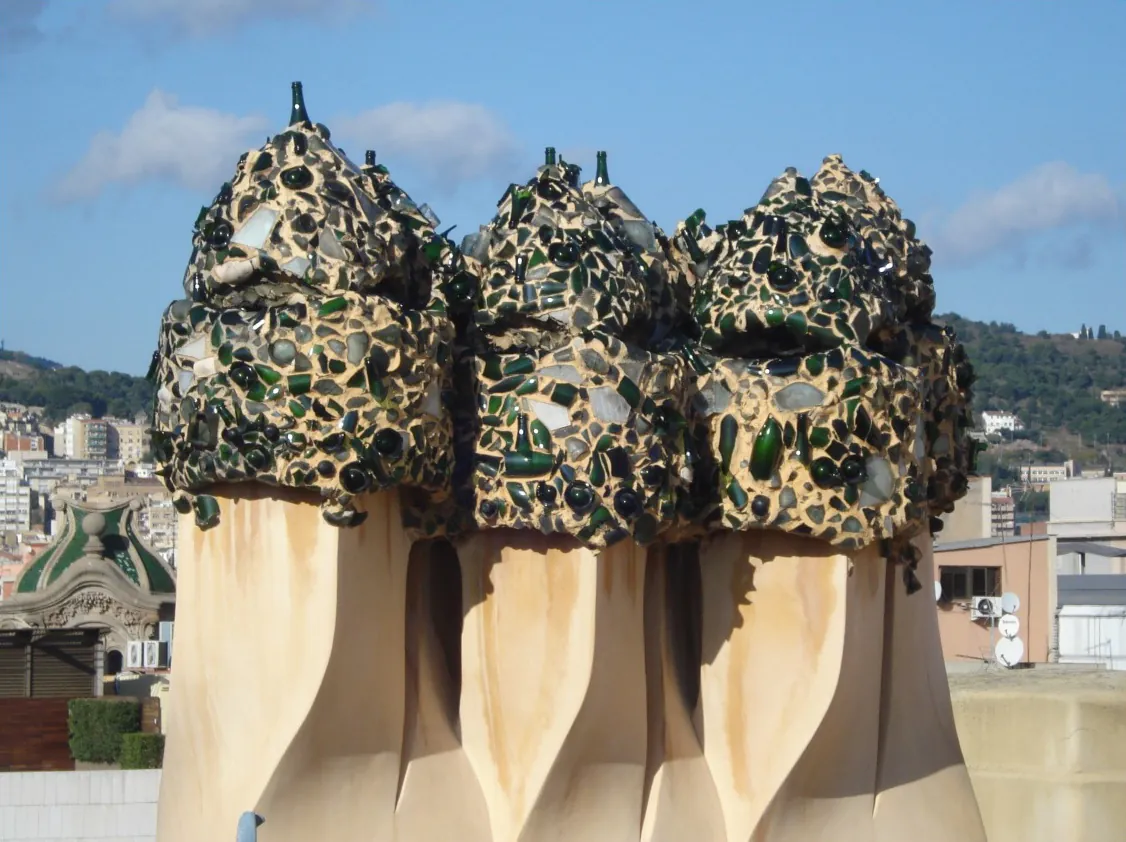
BUT there is another sculpture that Gaudí designed to crown his last secular work: Casa Milà, known as La Pedrera. A work carved in marble that the twists of fate left without a sky, and that was never put in place. A century later, it was discovered in an incredible, almost providential way. And even today, it is still waiting for its place… TO BE CONTINUED.