PAST
The Sagrada Família is a catechism. It is a liturgical calendar, a prayer. Everything is connected. Everything corresponds. And yet Gaudí built only part of it, and that was neither an accident nor a failure: it was his plan. Gaudí knew it. He knew he would not finish it, that others would have to continue what he had begun. And he accepted it, because he understood that the work of God is never finished, that it always remains open, always unfinished, always waiting for new hands. That is why he did not conceive it as a closed monument, but as an invitation: he left it alive, like a seed entrusted to time, so that each generation to come would have to decide whether to keep building or stand by and watch.
In his final months, Gaudí lived almost like a monk within the grounds of the Sagrada Família. His routine was an unchanging ritual: he rose before dawn, washed in cold water even in winter, and walked to the Oratory of Saint Philip Neri to attend vespers, speak with his spiritual director and, if necessary, go to confession. Then he returned to the temple and worked tirelessly until well into the afternoon, overseeing every detail, sculpting plaster models or correcting plans. He ate frugally, sometimes only a handful of nuts or a piece of bread, and dressed with an austerity that spoke of poverty: a shabby suit, worn-out shoes and a threadbare scarf. No one who saw him in the street would have guessed that this man was the most celebrated architect in Catalonia.
On that Monday, June 7, 1926, Gaudí, about to turn 74, left his workshop at the Sagrada Família as he did every afternoon. Before leaving, he said to one of his collaborators: “Vicens, come early tomorrow, for we will do very beautiful things.” It was six in the evening as he walked, lost in thought, along the Gran Vía, between Bailén and Girona streets, on his way to his church. As he crossed the road, he saw a tram coming and stepped back to avoid it. He did not notice that another tram was approaching from the opposite direction: the Line 30 tram. The impact was brutal. He fell to the ground with several broken ribs, internal bleeding and a concussion.
No one recognized him. His undernourished look, his sunken eyes and his wretched clothes led passersby to take him for a beggar. Taxi drivers refused to pick him up. Finally, a Civil Guard officer named Ramón Pérez stopped a taxi and forced the driver to take him to a first-aid post on the Ronda de Sant Pere, and from there to the Hospital de la Santa Creu, the hospital of the poor.
There, in a nameless bed, lay dying the genius who had transformed Barcelona. And there, precisely there, the prophecy he himself had sculpted twenty years earlier was being fulfilled: the death of the just. That man alone, abandoned, surrendering his soul to Jesus, Mary and Joseph, was no longer a sculpture in the cloister. He was Gaudí himself. The stone had foreshadowed life. The same place, the same poverty, the same loneliness. The same surrender.
The next day, June 8, his identity was confirmed. The news spread like wildfire through the city’s civil and ecclesiastical circles. That anonymous injured man was Antoni Gaudí, the master of the Sagrada Família. For three days he hovered between life and death. When he briefly regained consciousness at one point, all he was heard to murmur was: “My God, my God!” The medical report was bleak, and on June 10, 1926, at eight minutes past five in the afternoon, Antoni Gaudí died. He was 73 years old. He died righteous and at peace, with nothing between him and God.
His body was shrouded in the black habit of the Confraternity of Our Lady of Sorrows and laid in state in a makeshift funeral chapel at the hospital. Two days after his death on June 10, a countless crowd accompanied his coffin from the hospital, past the Cathedral, to the crypt of the Sagrada Família, where he has rested since Saturday, June 12, 1926.
The man who had built for a silent God, who had sown schools amid the fire and carved love as structure, died alone, mistaken for a beggar, but leaving behind him the work of a visionary that still grows today, stone by stone, toward the heaven he always dreamed of.
Dawn over Barcelona, 2025. We see the Sagrada Família nearly complete.
José Manuel Almuzara, on camera, atop La Pedrera. He looks at the chamfered corner.
A century later, the Sagrada Família nears completion. Pope Francis declared him Venerable. The whole world celebrates what Gaudí built. But here, high on this rooftop, on this chamfered corner overlooking Barcelona, something is missing. A stone is missing. The last stone.
Almuzara walks toward the edge. He takes out a manuscript.
This discovery is not an anecdote. It is a piece that was missing from the greatest puzzle of modern architecture. Because when I found the drawing by Joan Matamala — the sculptor who worked alongside his father, Llorenç, on the Sagrada Família — I did not find just a piece of paper. I found the only surviving image of the sculptural group Gaudí had conceived for La Pedrera. I found Gaudí’s final wish. The last thing he dreamed of for his last secular work. The stone that gives meaning to everything else. And that, believe me, keeps you up at night. He himself had said it: “La Pedrera is Gaudí’s last secular work, and it is missing its last stone, precisely the one that gives it meaning.” It had to be completed.
ALMUZARA
Since then, I have taken this story halfway around the world. I have told how Gaudí conceived La Pedrera as a gigantic pedestal for the Virgin. I have shown the manuscript. I have explained that the sculpture was never put in place because of fear, war, litigation. And at every lecture, when it ends, there is always someone who comes up and asks me the same thing: “Can’t anything be done?” And for years I gave the same answer: The sculpture does not exist. Only the drawing remains.
[Pause. Almuzara smiles.]
ALMUZARA
Until one day, in Guadalajara, Mexico, everything changed.
[Images of the city of Guadalajara. An auditorium. Almuzara speaking.]
ALMUZARA
The lecture was over. As always, someone raised a hand and asked: “Can’t anything be done?” And as always, I answered: “The sculpture does not exist. Only the drawing remains.” But that night, as I left the auditorium, a man was waiting for me. A Mexican businessman. He did not tell me his name. He did not give me a card. He said just one sentence to me: “I want that Virgin to exist.”
[Pause. The camera moves in.]
ALMUZARA
He did not hesitate. He set no conditions. He did not want the spotlight. He asked only to remain anonymous. And he funded the entire project. Out of his own pocket. Without asking for anything in return. Just like Isabel Bolet. Providence that arrived without a name.
Pause. Almuzara looks into the camera.
ALMUZARA
A century later, history repeated itself. Another anonymous donor. Another fortune given without conditions. Once again, Divine Providence working through someone who prefers not to be seen. Because there are hands that build and hands that sustain. And the hands that sustain are almost always invisible.
Images of Marco Augusto Dueñas in his studio, working the marble.
ALMUZARA
And to sculpt it, we sought out the best. Marco Augusto Dueñas. The only living Spanish sculptor with works in St. Peter’s Basilica in the Vatican. His sculptures of Saint Rafaela María and Saint Maron, four and a half and five and a half meters tall, stand alongside those of Michelangelo. He has worked white Carrara marble. He has created the four-meter Christ the Reconciler, installed in Lebanon. His art is monumental, classical, devotional.
Images of Dueñas at work. The hammer, the chisel, the marble dust.
ALMUZARA
Our benefactor contacted him. He explained the project to him. He showed him the Matamala manuscript. He told him about Gaudí. He told him about the Virgin. And Dueñas accepted. He said it would be an honor. He said that Gaudí was the architect who had taught him to look at the heavens. He said that sculpting that Virgin was, in a way, closing a circle he had not opened, but that he felt was his own.
Images of the finished sculpture. Our Lady of the Rosary, flanked by Michael and Gabriel. Bronze and stone. Light streams in through a large window.
ALMUZARA
The sculpture is finished. It exists. It is real. Our Lady of the Rosary, just over two meters tall, flanked by the archangels Michael and Gabriel. In bronze and stone. The work that Gaudí dreamed of, that Carles Mani made in plaster, that Joan Matamala drew, that Almuzara found, that a Mexican philanthropist funded and that Dueñas sculpted.
Pause. Almuzara looks at the sculpture. Then into the camera.
ALMUZARA
Three pieces. A century later. And what Gaudí dreamed of and could not see completed at last takes shape: La Última Piedra.
Pause. The camera moves in on the sculpture. The Virgin’s eyes.
ALMUZARA
But the story does not end here. Because this Virgin, though she exists, is not yet in her place. And that, precisely that, is what makes her more beautiful. Because it reminds us that God’s works are never finished. They are continued. And that the last stone, the missing one, the one that waits, is always waiting for hands to set it in place.
José Manuel Almuzara, on camera, atop La Pedrera. The empty chamfered corner. The wind.
ALMUZARA
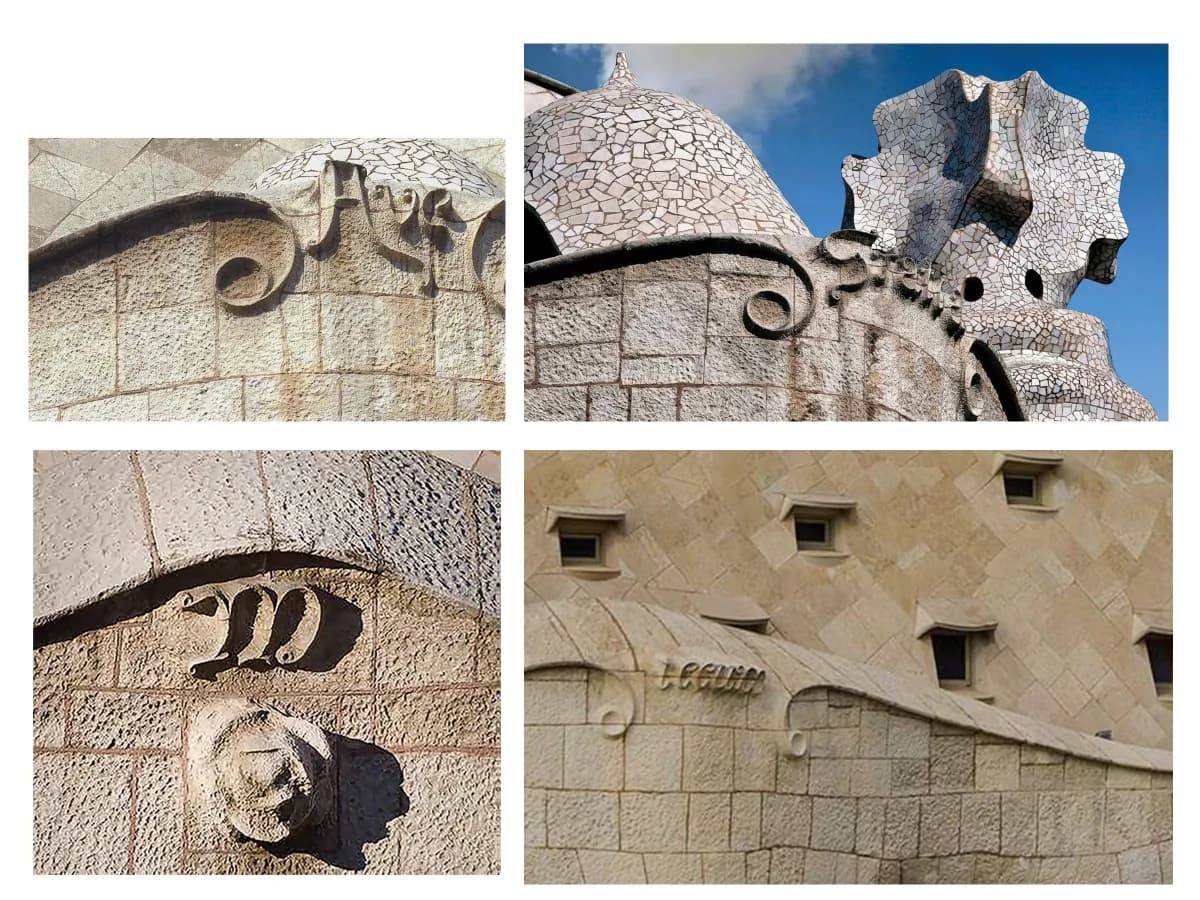
When the sculpture was finished, I took it upon myself to take the next step. This chamfered corner. This rooftop. This “M” for Mary carved into the cornice was its place. So I contacted the people in charge of La Pedrera. The Fundación Caixa Catalunya, which owns the building. I told them the story. I showed them the Matamala manuscript. I explained who Dueñas was. I told them about the Mexican donor. I told them that the sculpture existed, that it was ready, that it was only waiting for a crane and a permit.
Pause. Almuzara looks at the empty chamfered corner.
ALMUZARA
And their answer was clear. “We don’t want to, and we can’t.” A flat no. Heritage law prevented it. The volumetric typology of the protected building had to be preserved exactly as it was. Nothing could be added. Not a Virgin. Not an archangel. Not a single gram of gilded bronze on the “M” for Mary. La Pedrera, they said, is a work by Gaudí. And Gaudí left it this way. No crowning piece. No Virgin. And that is how it had to stay.
ALMUZARA
This refusal is not the first. Nor will it be the last. La Pedrera was born without its Virgin because the Milàs were afraid. The Tragic Week condemned it to oblivion. The lawsuit left it without its crowning piece. And now, a century later, bureaucracy leaves it without its last stone. It is as if fate had decided that this work should never be completed. As if La Pedrera were condemned to remain forever unfinished.
Pause. The camera moves in.
ALMUZARA
And then, thinking it over, I realized something. This is not a failure. This is exactly what Gaudí wanted to teach us. Because Gaudí never saw his work finished either. He never saw the Sagrada Família completed. He never saw La Pedrera crowned. He never saw his Virgin in place. And yet he did not give up. He kept building. He kept believing. He kept loving. Even though he could not see the end. Even though he received nothing in return. Even though everything seemed lost.
Images: an elderly Gaudí, working. The Sagrada Família under construction. The scaffolding.
ALMUZARA
Because faith does not mean knowing that everything will turn out well. It means carrying on even when it does not. It does not mean seeing the end. It means walking without seeing it. It does not mean having certainties. It means having trust. And Gaudí had that trust until his last day. Until the tram. Until the bed in the hospital of the poor. Until his last breath. Because he knew the work was not his. It was God’s. And God finishes what He begins. Even if we do not see it.
Pause. Almuzara looks into the camera.
ALMUZARA
So this “no” from La Pedrera is not an ending. It is an invitation. The same invitation Gaudí has been extending to us for a century: do not give up. Day by day. With patience. With love. With faith. Even when you cannot see the end. Even when you receive nothing in return. Even when everything seems lost.
Long pause. The wind on the rooftop. The city below.
ALMUZARA
Because Gaudí did not build for himself. He built for God. And God does not hold on to anyone’s work. God continues. God completes. God crowns. And if La Pedrera cannot have its Virgin, it will have her somewhere else. In the heart of whoever learns this story. In the memory of whoever tells it. In the faith of whoever receives it. Because there are works that are not finished with stone. They are finished with memory. They are finished with love. They are finished with faith.
That is why Gaudí’s last stone is all of us. We are the ones who must carve, day by day, with patience and with love, the missing stone. The ones who must follow in his footsteps.
Images: hands carving stone. Children at Gaudí’s school. The Sagrada Família rising.
ALMUZARA
Gaudí sculpted his death without knowing it, but he also sculpted his resurrection: a work he would not see finished, but which was destined never to be finished. Because God’s works do not come to an end. They are only continued.
Shot: the sculpture of the Virgin, illuminated. Then, the empty chamfered corner of La Pedrera.
The camera rises. Aerial view of Barcelona. The Sagrada Família and La Pedrera connected by the gaze.
Long pause. The music stops.
Final image: Gaudí, young, at the Sagrada Família. He looks up. He smiles. He weeps. The camera climbs the towers to the sky, and we reveal the grandeur of the Sagrada Família, now nearly complete.
ON-SCREEN TEXT
In memory of Antoni Gaudí (1852–1926). Venerable since 2025. The Sagrada Família is still being built. The last stone is still waiting.
END OF THE SERIES.